Photo Gallery

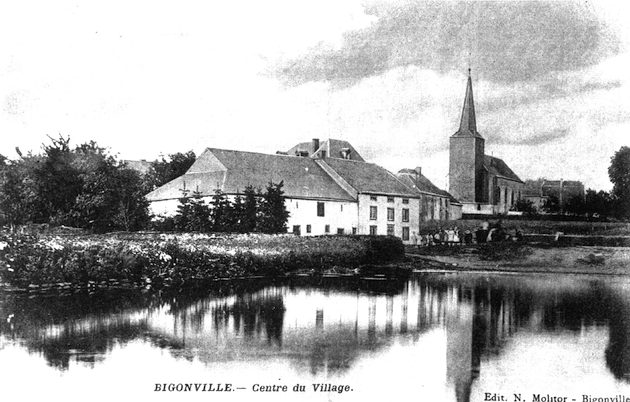
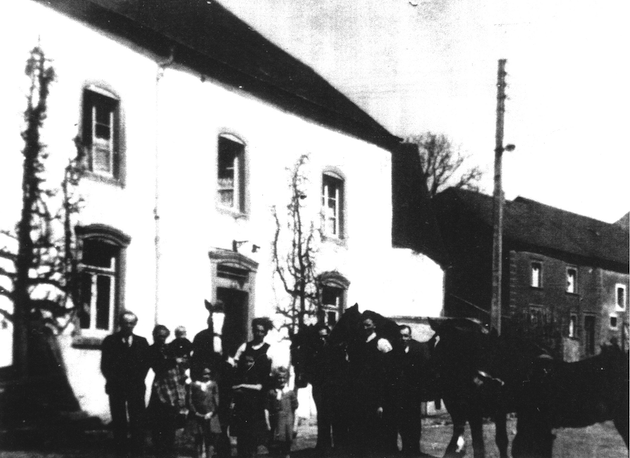
The village prior to the Battle of the Bulge

-

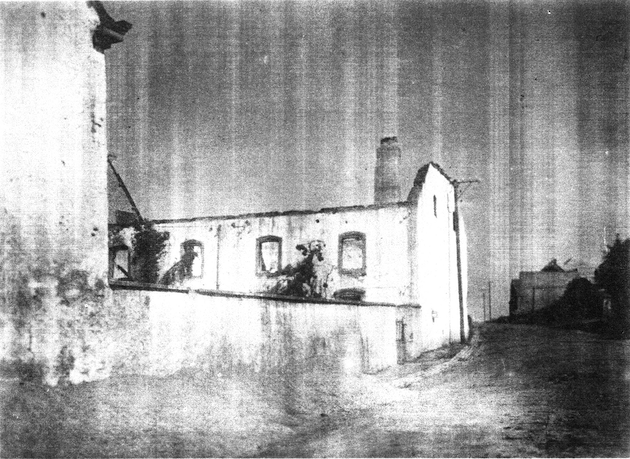
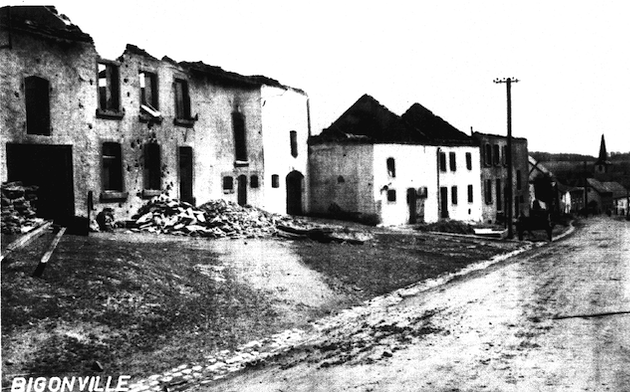
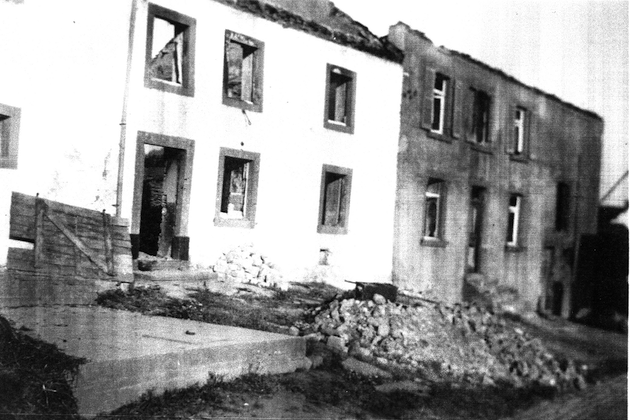
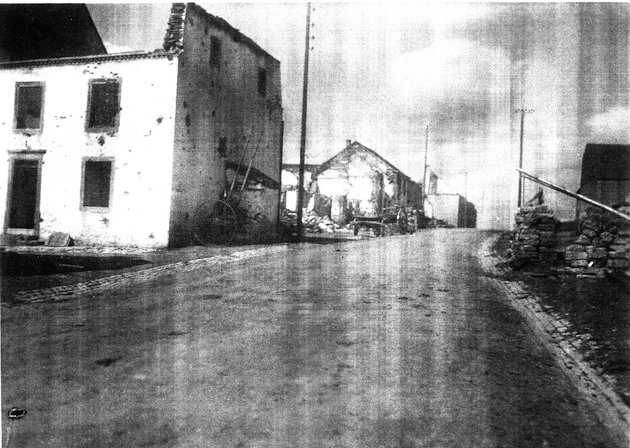
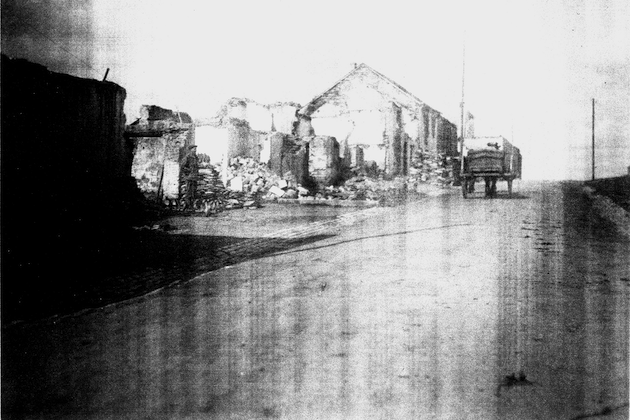
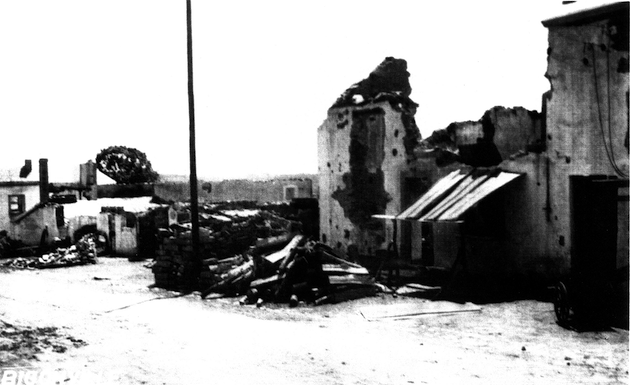
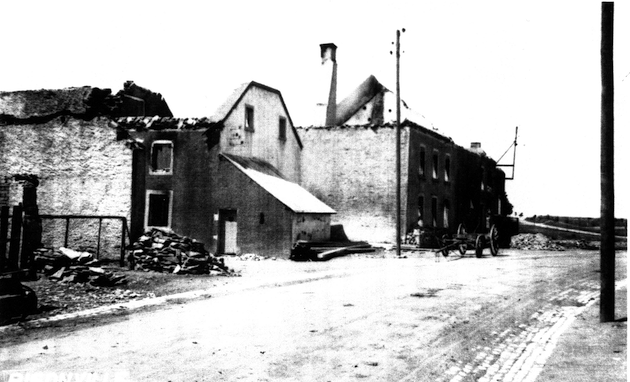
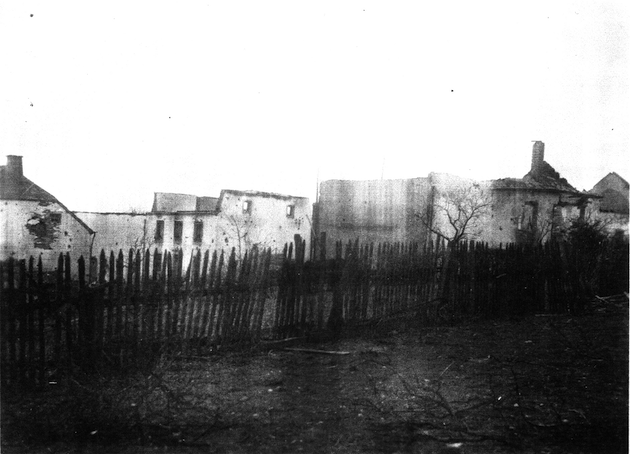
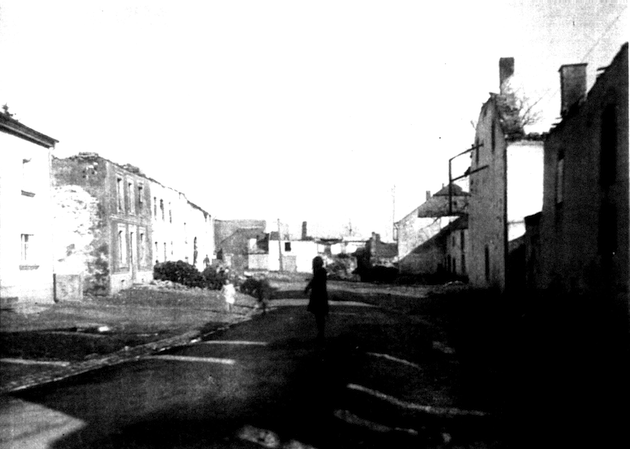
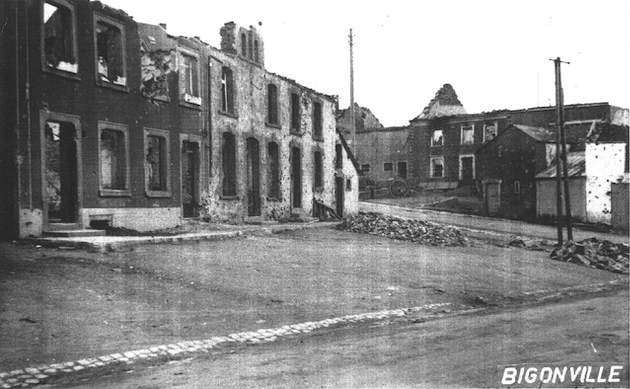
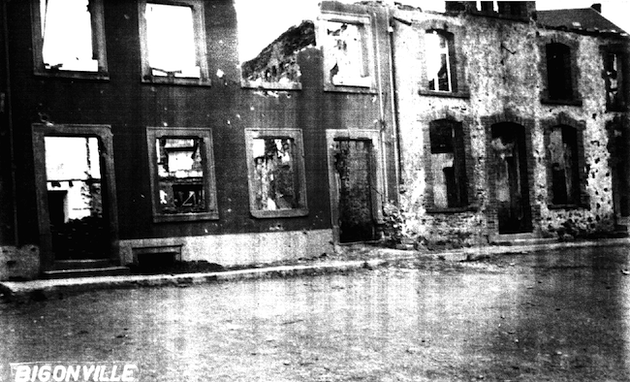
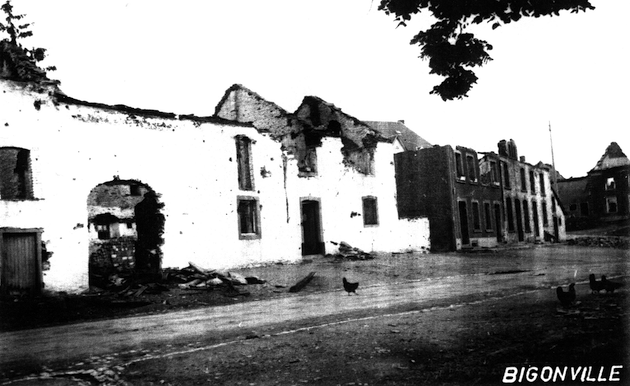
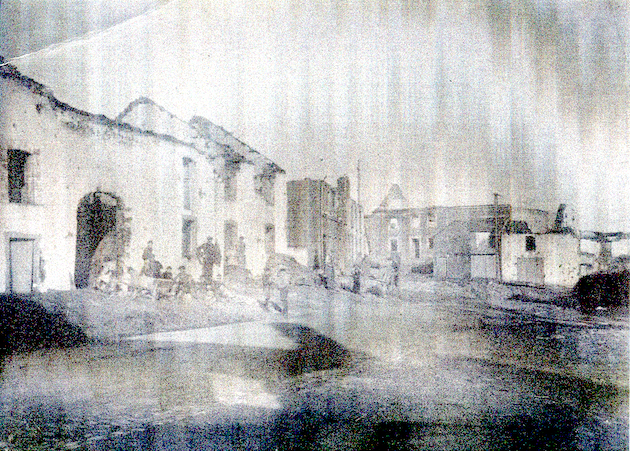
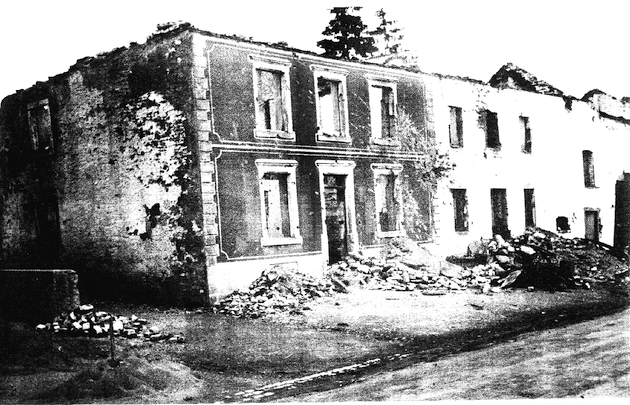
Damaged and destroyed buildings as in 1945

The outcome of the Battle of the Bulge was devastating for Bigonville: 43 houses completely burned down, 64 residential buildings damaged.

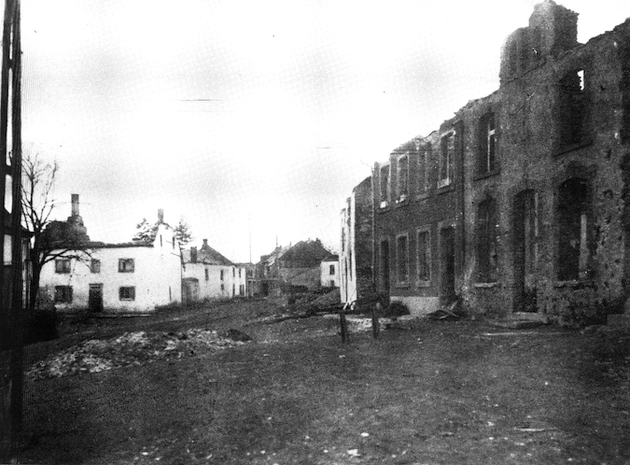
Street scene in black-and-white showing clear signs of wartime destruction. The street surface transitions into bare ground scattered with small debris and rubble. On the left, a row of houses whose facades are mostly still standing but severely damaged. The building walls are marked by bullet holes, cracks, and broken masonry, with sections of the exterior having crumbled away. The roof of the frontmost house is entirely missing, while the others have partially or completely collapsed roofs. The street curves to the right and continues into the background, lined with more buildings that are also badly damaged.
1) Destroyed houses at ‘Keismart’. Photo by Nic. Molitor[]
Black-and-white photo of a damaged building, the facade shows clear signs of destruction: plaster has partially fallen off, some window frames are broken or missing, and there are visible bullet holes or larger damages on the walls.
2) The destroyed house ‘a Schmiitz’. Photo: Schumacher-Raas family [today: 3 rue Principale]
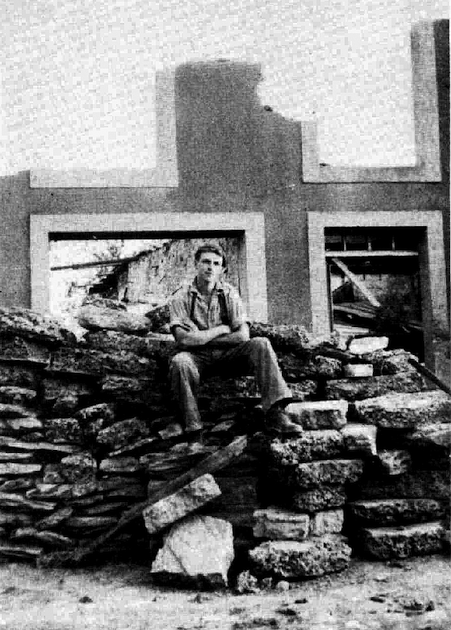
Black-and-white photo of a young man sitting with his arms crossed on a pile of rough stones or rubble. In the background, there’s a partially destroyed wall of a building with large, empty window or door frames—roof and parts of the wall are missing.
3) Alphonse Thomas sitting in front of his completely destroyed home ‘beim Thoma’. Photo: Thomas family [today: 5 rue Principale]
Black-and-white photograph showing the ruins of the heavily damaged farmhouse ‘a Mechels’ situated alongside a curved road. The structure appears to have been a two-story house, now largely destroyed: the roof is almost completely missing, only parts of the outer walls remain standing. The windows are empty or boarded up, and the facade is marked by numerous holes and damage from gunfire or explosions. In front of the building is a large pile of rubble and debris.
4) The destroyed farmhouse ’a Mechels’ in the center of Bigonville (not rebuilt later on). Photo by Nic. Molitor
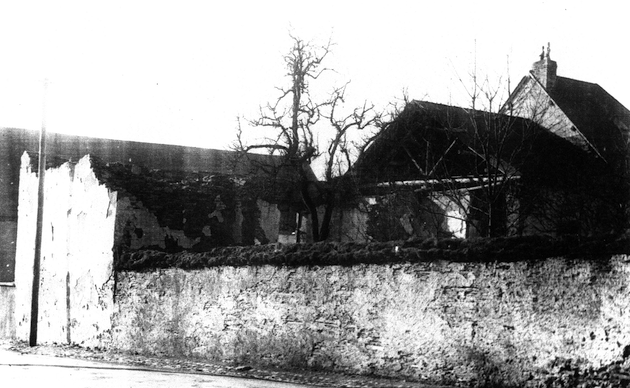
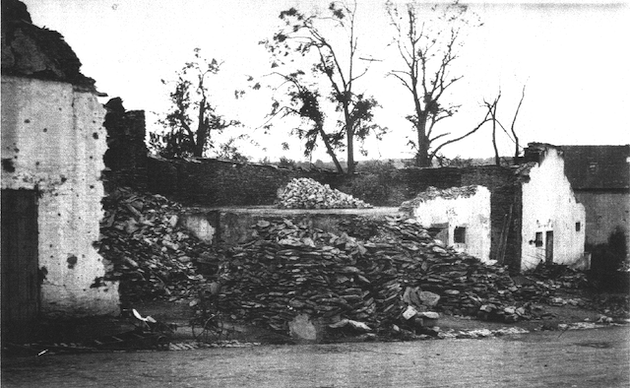
Black-and-white photograph of an old, partially ruined house facade. In the foreground, a high, weathered stone wall running parallel to a street with cracks and peeling plaster. Behind the wall, there are several leafless trees with twisted, bare branches. The main building visible behind the wall appears to be in a state of disrepair. The roof is partially collapsed or missing in places, and the walls are heavily weathered, with large patches of plaster missing, exposing the underlying structure. To the right, another building is visible, with a more intact roof and a chimney, in better condition than the ruined structure in the center.
5) The destroyed farm ’a Mechels’ in the center of Bigonville (only partially rebuilt later on). Photo by Nic. Molitor [today: 13 rue Principale]
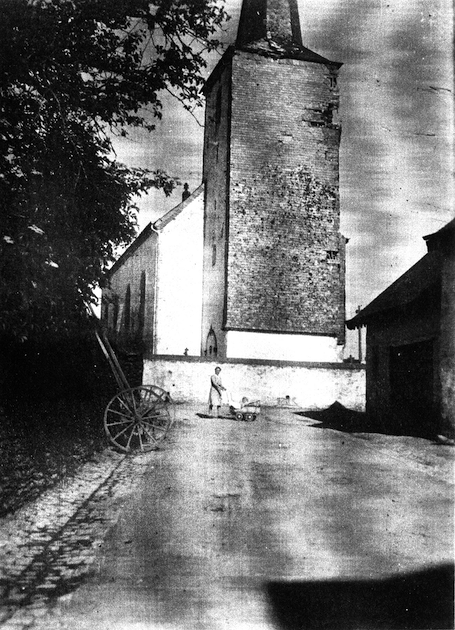
Black-and-white photograph showing the tall, rectangular stone tower of the Bigonville church with a pointed roof, the building appears weathered, with visible texture on the stonework. Attached to the tower is the main body of the church with a sloped roof and a few small, arched windows. In the foreground stands a woman, pushing an old-fashioned baby carriage. The road in front of the church is unpaved, with a strip of cobblestones along the edge. On the right side of the image, there is another building partially visible.
6) The church tower received several hits during the battle for Bigonville. Photo by Nic. Molitor
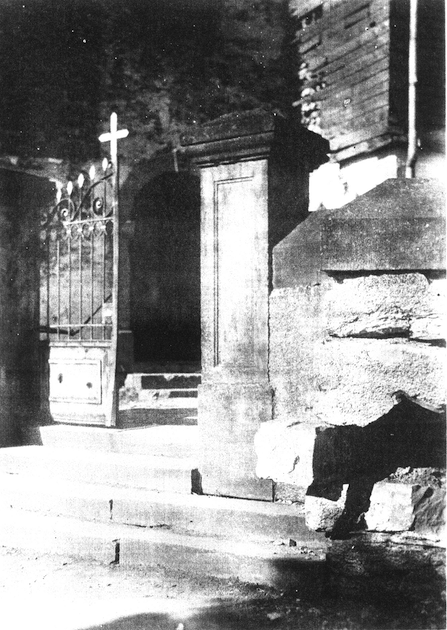
Black-and-white photograph of the stone entrance area to the Bigonville church with several broad stone steps leading up to an open wrought-iron gate in a roughly built stone wall with large, uneven blocks. Behind the gate, the archway church entry, showing worn stones and weathered surfaces.
7) Entrance to the church and old cemetery area showing war damage. Photo by Nic. Molitor
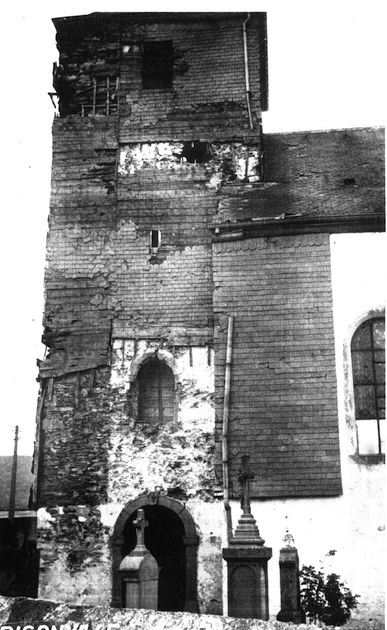
Black-and-white photograph of the old, heavily damaged church facade. The tower and adjoining wall above the rounded archway entrance show significant signs of decay: the masonry is crumbling, plaster is peeling off, and many of the roof shingles are missing or broken. The upper part of the tower showing a small window appears especially dilapidated, with exposed wooden beams and large patches where the outer covering has fallen away. The church windows are either barred or bricked up, the overall structure looks war-damaged.
8) The Bigonville church showing battle damage after beeing used by German snipers to harrass advancing US troops. Photo by Nic. Molitor
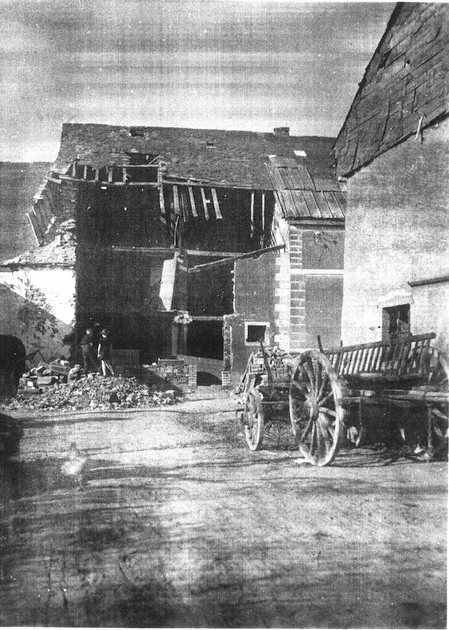
Black-and-white photograph showing a building that suffered significant damage: the roof is partially collapsed, with exposed beams and missing tiles. The upper part of the wall is broken, and debris is scattered around. The structure looks unstable, with bricks and wooden elements jutting out. To the left, two people are standing on a pile of rubble, possibly engaged in repair work.
9) The former house ‘Kounter’ near the church, damaged by artillery hit. Photo by Nic. Molitor
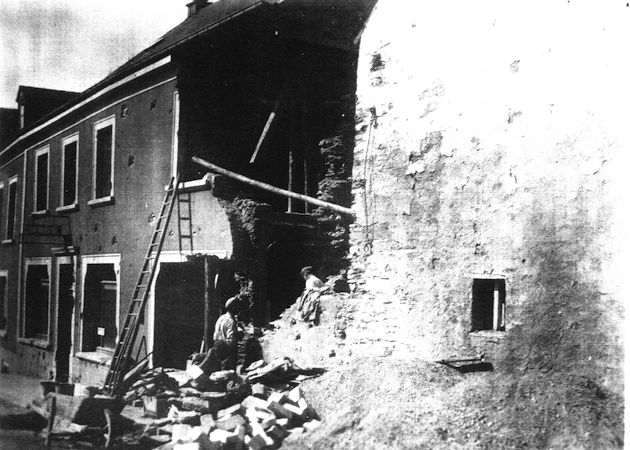
Black-and-white photograph of a damaged building facade. On the left side of the image, there is a multi-story structure with several windows. A long ladder is leaning against the building, reaching up to the first floor. In the foreground, there is a large pile of bricks and rubble scattered on the ground. Two people are present: one is standing on the ground near the rubble, while the other is sitting or crouching on the damaged wall itself. The right side of the image is dominated by a large, rough wall with peeling plaster and exposed brickwork.
10) The Hotel-Restaurant ‘a Mulitors’. Photo by Nic. Molitor [today: 23 rue Principale]
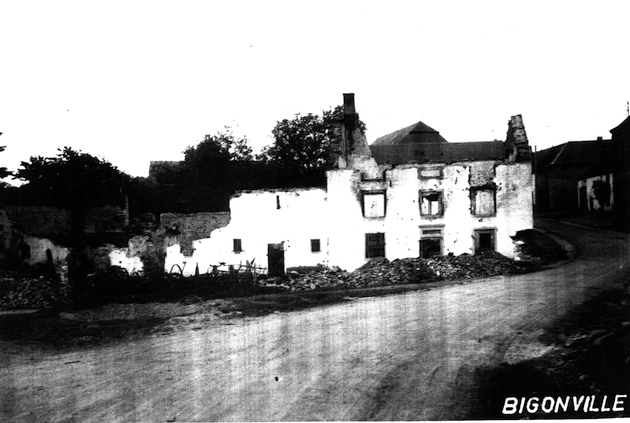
Black-and-white photograph showing a building on the right side of a street. White plastered walls that appear weathered and stained, showing clear signs of destruction. The roof is missing, rises into a small gable on the right side, topped with a tall chimney. No window panes or frames. The building is bordered by a low wall in the foreground. The street in front of the building is unpaved, appearing rough and dusty.
11) The burned farmhouse ‘an Heetz’. Photo by Nic. Molitor [today: 25 rue Principale]

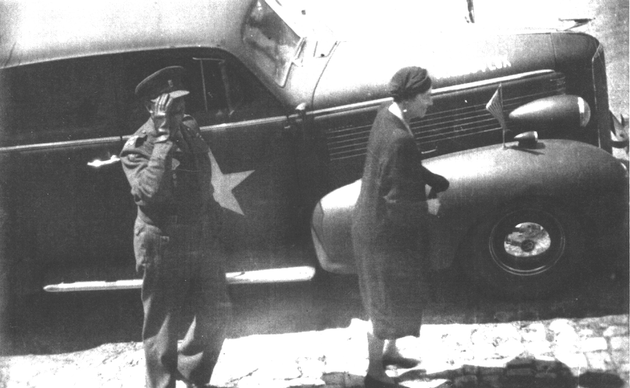
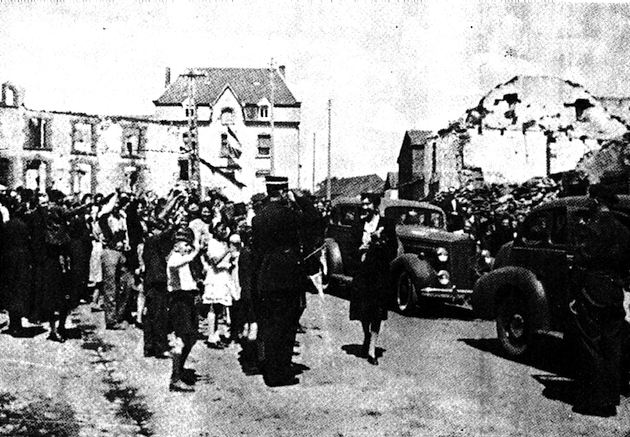
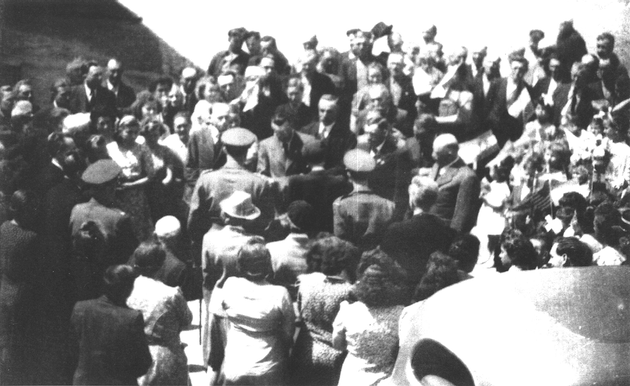
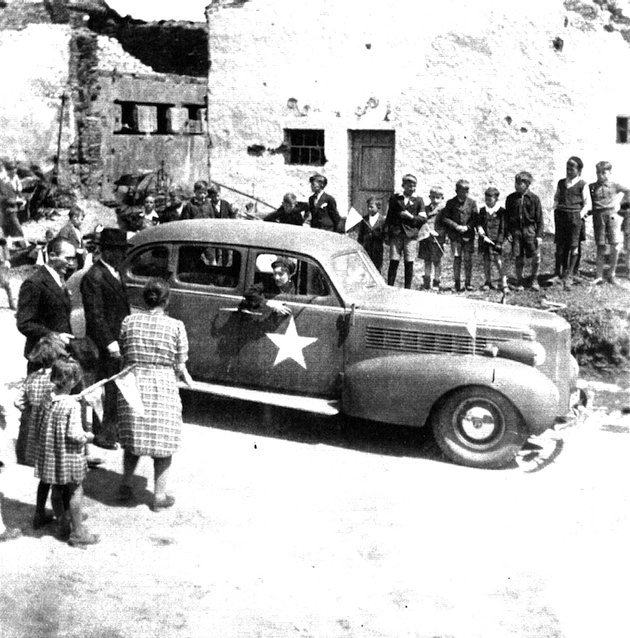
The Grand-Duchesse visiting the village, 14 May 1945

--
--
--
--

Reconstruction

The reconstruction was carried out under the supervision of architect Alber De Lay from Luxembourg by the contractors Gust. Wolff from Useldange and Jos. Bodevin from Nagem.

Black-and-white postcard of a village center. In foreground, a grassy field bordered by a simple fence. Behind it stand several old buildings. A narrow road winds through the village, a person is walking along with a cow. In the background, more houses and trees can be seen.
Bigonville, Centre du village. Edit.: Epicerie Math. Gillen, Bigonville
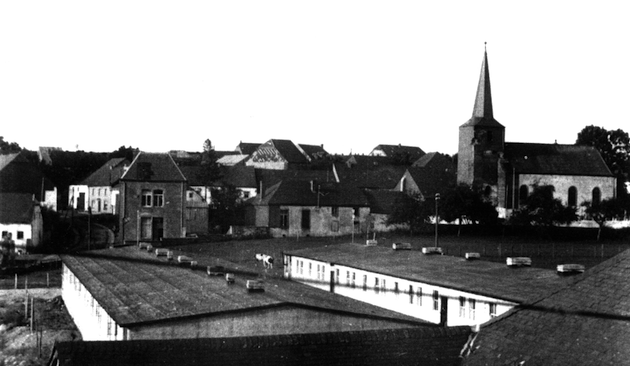
Black-and-white photograph with several buildings. In the foreground, two flat, elongated barracks with flat roofs. Residential houses with gabled roofs and a church in background.
The government had two emergency barracks built, the ‘Buden’ (a total of 18 apartments with four rooms each) in ‘Freiesch-Pesch’. Photo by Nic. Molitor [today: Town Hall ‘Centre Culturel’]
Black-and-white photograph of a man leading a horse pulling a plow. In background, fields, hedgerows, and a small village with several houses.
François Felten working in a field ‘um Berrig’, early 1950s with Bigonville in the background. Photo: Felten-Goller family
Black-and-white aerial view of several residential houses, gardens, and fields. In the foreground, a larger building with the signs 'RESTAURANT' and 'HOTEL'. The streets are narrow and winding, with some trees lining the roads. In the lower right corner, a small group of people can be seen on the street.
View of the Pesche-Rausch Hotel-Restaurant and the ’Keismart’-area. The reconstruction is almost complete, the light-colored roofs beeing covered with sheet metal. Carte postale, Messageries Paul KRAUS - Luxembourg, Cliché Combier - Mâcon